
Introduction: A Surprising Mathematical Breakthrough
Mind-Blowing Math Breakthrough: In a remarkable development that has captured global attention, a group of American high school students has made a surprising contribution to one of the most famous principles in mathematics: the Pythagorean Theorem. This theorem, known for more than two thousand years, forms the foundation of geometry and is taught in classrooms around the world.
While the theorem itself has long been proven and widely understood, these students discovered a new and elegant way to demonstrate it using advanced mathematical techniques. Their work has impressed mathematicians and educators alike, proving that innovation in mathematics can come from unexpected places.
The students’ approach not only offers a fresh perspective on a classical theorem but also highlights the power of curiosity, creativity, and collaboration in learning mathematics.
In this article, we explore what the Pythagorean Theorem is, what the students discovered, how their proof works, and why this achievement has sparked excitement across the scientific community.
Understanding the Pythagorean Theorem
The Pythagorean Theorem is one of the most fundamental principles in geometry. It describes the relationship between the sides of a right triangle.
The theorem states that:
The square of the hypotenuse equals the sum of the squares of the other two sides.
In mathematical form:
a² + b² = c²
Where:
- a and b are the two shorter sides of a right triangle
- c is the longest side, called the hypotenuse
This simple relationship is used in countless fields, including architecture, engineering, physics, computer graphics, and navigation.
The theorem is traditionally attributed to the ancient Greek mathematician Pythagoras, although evidence suggests that similar mathematical ideas existed in earlier civilizations such as Babylon and India.
Why the Pythagorean Theorem Is So Important
The impact of the Pythagorean Theorem cannot be overstated. It forms the backbone of geometry and spatial reasoning.
The theorem allows mathematicians and engineers to calculate distances, design structures, and solve real-world problems involving angles and measurements.
Examples of its applications include:
- Designing buildings and bridges
- Calculating distances in maps and navigation
- Programming graphics in video games
- Measuring satellite trajectories
- Engineering modern infrastructure
Because of its importance, mathematicians throughout history have developed hundreds of different proofs of the theorem.
Yet the discovery made by these American students introduced a proof that had never been formally demonstrated before.
The Unexpected Discovery by American Teenagers
The remarkable breakthrough came from a group of talented American high school students participating in a mathematical research program.
While studying geometry and trigonometry, the students began exploring alternative ways to prove the Pythagorean Theorem.
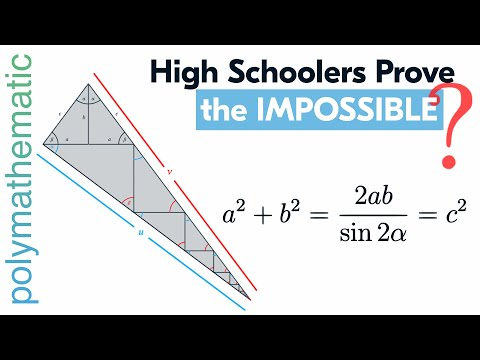
Most proofs rely on geometric constructions or algebraic identities. However, the students examined the theorem through a branch of mathematics called Trigonometry.
Their goal was to explore whether certain trigonometric identities could be used to prove the theorem in a novel way.
What they discovered surprised even professional mathematicians.
A New Type of Proof Using Trigonometry
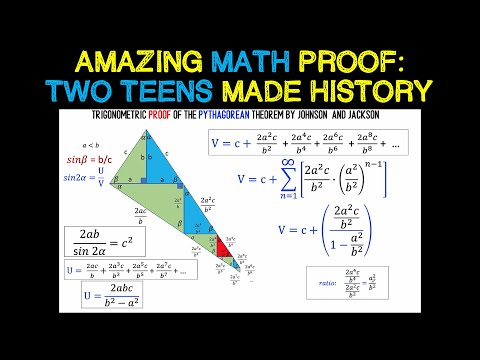
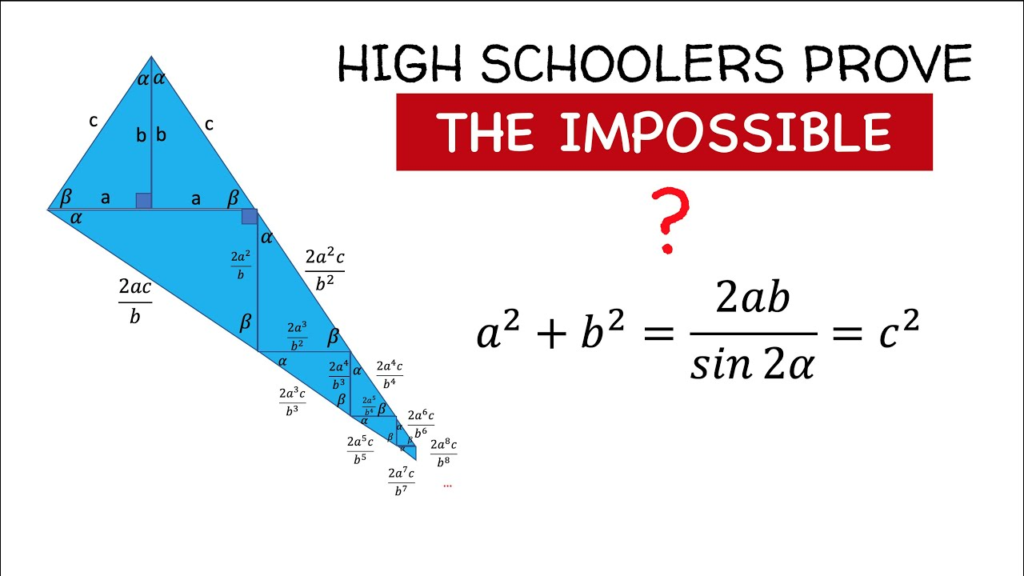
The students developed a unique proof using advanced concepts from Trigonometry.
Traditionally, mathematicians believed that trigonometric proofs of the theorem could create logical circular reasoning. In simple terms, trigonometry formulas often rely on the theorem itself.
This made it difficult to construct a proof that used trigonometry without indirectly assuming the theorem was already true.
However, the students carefully examined a specific trigonometric identity and discovered a way to avoid this circular reasoning.
Their approach showed that it was indeed possible to prove the Pythagorean Theorem using trigonometry alone.
Why Mathematicians Are Excited
Although the theorem itself has been proven many times before, the students’ work represents an important intellectual achievement.
Mathematics thrives on new ideas, perspectives, and elegant solutions. Even when a theorem is already known, discovering a new proof can deepen our understanding of mathematical relationships.
The students’ proof also demonstrates how modern mathematical thinking continues to evolve.
Professional mathematicians praised the students for their creativity and analytical skills. Their work shows that meaningful contributions to mathematics can come from young minds willing to explore unconventional ideas.
The Power of Mathematical Curiosity
One of the most inspiring aspects of this discovery is that it emerged from curiosity-driven learning.
Instead of simply memorizing formulas, the students asked deeper questions:
- Why does the theorem work?
- Can it be proven in different ways?
- Are there unexplored mathematical paths?
This mindset is at the heart of mathematical discovery. Many of the greatest breakthroughs in history began with simple questions.
The students’ achievement highlights the importance of encouraging exploration and creative thinking in mathematics education.
The History of the Pythagorean Theorem
The Pythagorean Theorem has fascinated mathematicians for thousands of years.
The theorem is traditionally linked to Pythagoras, who lived around 500 BCE. His followers studied geometry extensively and believed mathematics revealed the hidden structure of the universe.
However, historians believe that knowledge of the theorem existed even earlier.
Ancient Babylonian tablets dating back nearly 4,000 years contain numerical patterns that correspond to the theorem. Similar geometric insights were also present in ancient Indian and Chinese mathematics.
Over centuries, mathematicians have produced more than 300 different proofs of the theorem using geometry, algebra, and calculus.
Why New Proofs Still Matter
Some people may wonder why mathematicians continue studying a theorem that has already been proven.
The answer lies in the nature of mathematical discovery. Each new proof reveals new insights about mathematical relationships and structures.
Different proofs may highlight connections between various fields of mathematics, such as algebra, geometry, and trigonometry.
In some cases, new proofs also lead to the discovery of entirely new mathematical concepts.
The students’ proof adds another chapter to the long history of exploration surrounding the Pythagorean Theorem.
The Role of Young Minds in Scientific Progress
The discovery also reminds us that groundbreaking ideas are not limited to professional researchers.
Throughout history, young thinkers have made important contributions to science and mathematics.
When students are given opportunities to explore, experiment, and question assumptions, they can produce extraordinary results.
This story serves as a powerful example of the potential of student-led research and the importance of nurturing intellectual curiosity.
How Mathematics Continues to Evolve
Mathematics is often perceived as a finished body of knowledge. However, it is constantly evolving as new ideas and connections emerge.
Researchers continue to explore unsolved problems, discover new patterns, and develop innovative proofs.
Even classical concepts like the Pythagorean Theorem can still inspire fresh perspectives.
The students’ achievement illustrates that mathematics is not just about learning established formulas—it is about exploring the unknown.
The Educational Impact of the Discovery
Educators around the world have welcomed the story as a powerful example of the value of inquiry-based learning.
When students are encouraged to investigate mathematical ideas rather than simply memorizing them, they develop deeper understanding and stronger problem-solving skills.
Stories like this can inspire future generations to pursue careers in mathematics, science, and engineering.
The discovery also highlights how collaborative learning environments can spark innovative thinking.
Conclusion: A New Chapter in a Timeless Mathematical Story
The Pythagorean Theorem has stood as one of the most iconic principles in mathematics for more than two thousand years.
Yet the recent discovery by American high school students demonstrates that even the most familiar ideas can reveal new surprises.
By developing a novel trigonometric proof, the students have contributed to the long and fascinating history of mathematical exploration.
Their achievement is a reminder that curiosity, creativity, and determination remain the driving forces behind scientific progress.
In the end, this story is not just about a mathematical theorem—it is about the limitless potential of human curiosity and the power of young minds to reshape the way we understand the world.
FAQs
1. What is the Pythagorean Theorem?
The Pythagorean Theorem is a fundamental rule in geometry that describes the relationship between the three sides of a right triangle. It states that the square of the longest side (the hypotenuse) equals the sum of the squares of the other two sides:
a² + b² = c².
2. Who originally discovered the Pythagorean Theorem?
The theorem is traditionally attributed to the ancient Greek mathematician Pythagoras, who lived around 500 BCE. However, evidence suggests that earlier civilizations such as the Babylonians and Indians had already discovered similar mathematical relationships.
3. What did the American teens actually discover?
The students developed a new way to prove the Pythagorean Theorem using ideas from Trigonometry. Their work showed a fresh perspective on how the theorem can be demonstrated mathematically.