
Introduction
Mind-Control Breakthrough: In a groundbreaking and somewhat unsettling development, scientists in China have reportedly turned ordinary bees into remotely controlled “cyborg” insects. This innovative yet controversial advancement in bio-robotics has sparked worldwide debate among researchers, environmentalists, and the general public. By integrating tiny electronic devices into the bodies of living bees, scientists can guide their movements, effectively transforming them into living drones.
This technological breakthrough could potentially revolutionize fields such as search-and-rescue operations, environmental monitoring, agriculture, and even national security. However, it also raises serious ethical, ecological, and privacy concerns. In this article, we explore how Chinese scientists created cyborg bees, the science behind the technology, potential applications, and the global reaction to this astonishing development.
What Are Cyborg Insects?
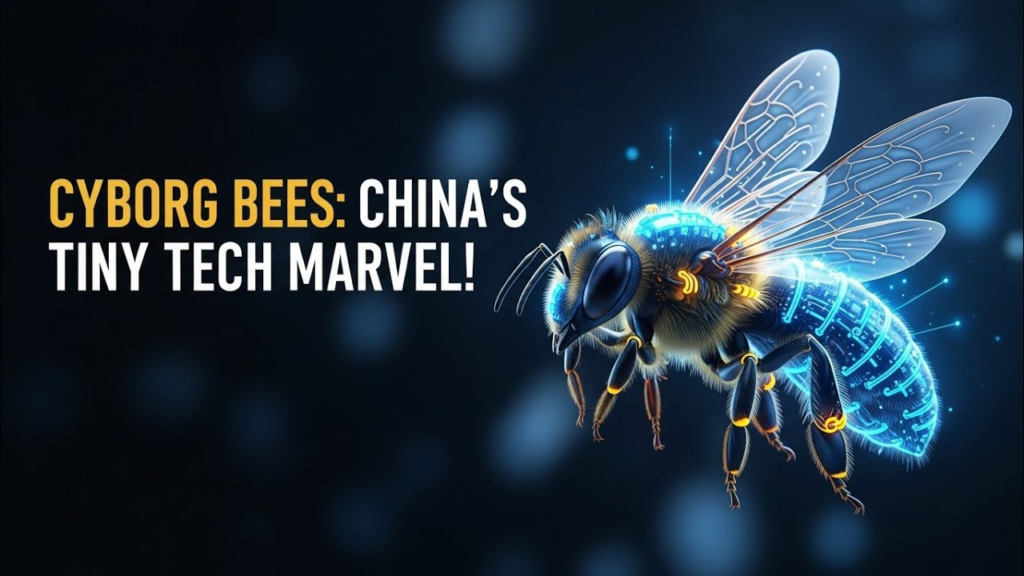
The term “cyborg insect” refers to a living insect that has been integrated with electronic components allowing scientists to control or influence its movements. Unlike traditional robots, cyborg insects use their natural biological systems—such as wings, muscles, and navigation instincts—while electronic implants provide external guidance.
Researchers have experimented with various insects, including beetles, cockroaches, and moths. Bees, however, present a unique advantage due to their small size, agility, and natural ability to navigate complex environments.
Cyborg insect technology merges biology with robotics, creating hybrid organisms capable of performing tasks that would be difficult or expensive for mechanical drones.
The Chinese Cyborg Bee Experiment
Chinese researchers recently unveiled a tiny brain-control device designed to manipulate the movement of bees. The device is incredibly lightweight—small enough to be mounted on the back of a bee without preventing it from flying.
The technology works by delivering tiny electrical impulses to the insect’s nervous system. These signals influence the bee’s muscles and navigation behavior, allowing scientists to guide its direction.
Key Features of the Device
- Ultra-lightweight microcontroller chip
- Flexible electronic probes connected to the bee’s brain
- Wireless signal receiver
- Battery small enough not to hinder flight
Scientists claim that the device can control the bee’s flight path with remarkable precision.
How Scientists Control Bees Remotely
To transform a bee into a cyborg, researchers carefully attach a miniature electronic chip to its body. Tiny electrodes are inserted into specific parts of the bee’s nervous system that control movement and orientation.
Once the chip is activated, scientists can send electrical signals to the electrodes using a remote transmitter. These signals stimulate the bee’s nervous system, causing it to turn left, right, or change direction.
The Control Process
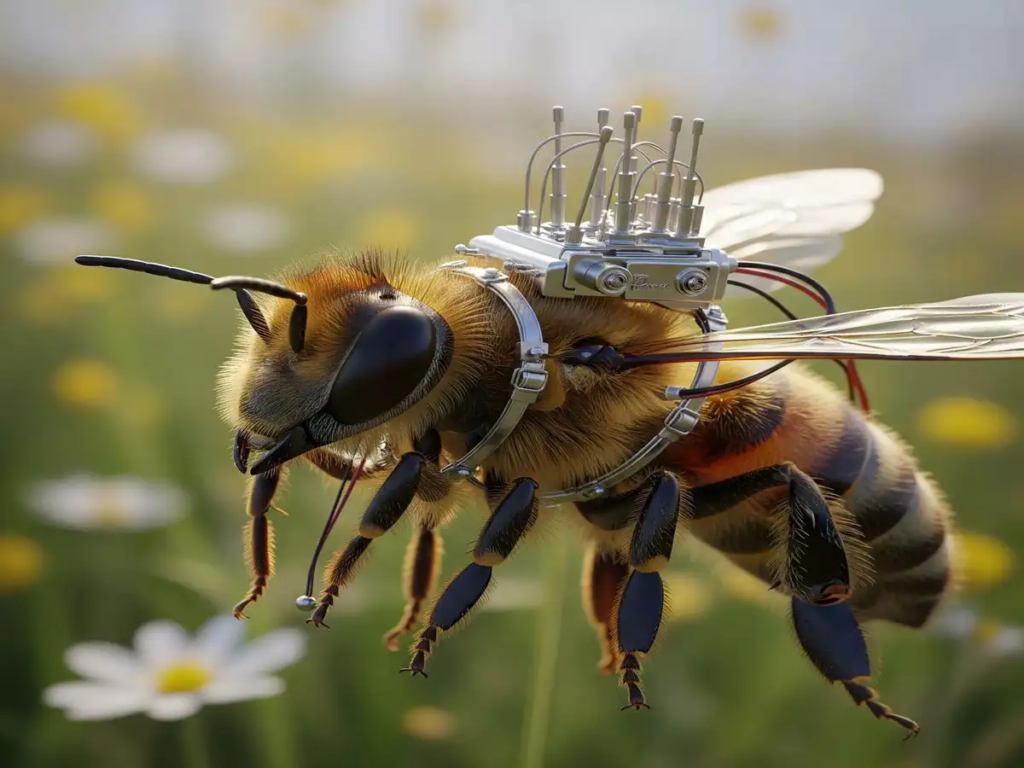
- The bee is fitted with a microchip backpack.
- Electrodes connect the chip to the insect’s neural system.
- Researchers send signals through a wireless transmitter.
- The bee responds to the signals and changes its movement.
This process essentially allows scientists to “steer” the bee like a tiny flying robot.
Why Scientists Are Creating Cyborg Bees
At first glance, turning bees into remote-controlled insects may sound like science fiction. However, scientists believe the technology could solve several real-world problems.
1. Search and Rescue Missions
Bees can fly through narrow spaces that drones cannot access. Cyborg bees could be used to locate survivors trapped under collapsed buildings after earthquakes or disasters.
2. Environmental Monitoring
Bees could carry tiny sensors to detect pollution, toxic chemicals, or radiation in hard-to-reach environments.
3. Agricultural Research
Since bees already play a crucial role in pollination, scientists could use cyborg bees to monitor crop health and plant conditions more effectively.
4. Military and Security Applications
Some experts believe cyborg insects could be used for surveillance or reconnaissance missions. Because insects are common in nature, they would attract far less attention than mechanical drones.
Advantages of Using Cyborg Bees
The concept of bio-robotic insects offers several advantages over traditional robotic drones.
Energy Efficiency
Unlike drones, insects already have biological systems designed for flight. This reduces the need for heavy batteries and complex motors.
Natural Navigation
Bees are naturally skilled navigators capable of traveling long distances and finding their way back to their hive.
Low Cost
Producing mechanical drones can be expensive. Using insects could dramatically lower costs for certain types of missions.
Stealth
Because bees are common in the environment, they are unlikely to attract attention.
Ethical Concerns Surrounding Cyborg Insects
Despite the potential benefits, the idea of controlling living creatures raises significant ethical questions.
Animal Welfare
Critics argue that inserting electronic devices into insects may cause harm or stress to the animals.
Environmental Impact
If cyborg insects were widely deployed, they could potentially disrupt natural ecosystems.
Military Misuse
One of the biggest concerns is that governments might use cyborg insects for surveillance or covert operations.
Privacy Issues
If insects could carry cameras or microphones, it could open the door to new forms of surveillance.
Scientific Challenges and Limitations
Although the technology is impressive, it still faces many limitations.
Battery Life
The tiny electronic devices used in cyborg insects have very limited battery capacity.
Control Accuracy
Scientists can influence the insect’s direction, but they cannot fully control every aspect of its behavior.
Biological Variability
Every insect behaves slightly differently, which can make consistent control difficult.
Device Durability
The electronic implants must be durable enough to survive flight and environmental conditions.
The Future of Bio-Robotic Insects
The development of cyborg bees is part of a larger field known as bio-robotics, where scientists combine living organisms with technology.
In the future, researchers may create even more advanced hybrid systems, such as:
- Insects equipped with environmental sensors
- Bio-robotic pollinators to support agriculture
- Swarms of cyborg insects for disaster response
- Medical micro-robots inspired by insect biology
Advances in microelectronics, artificial intelligence, and neural engineering will likely make these technologies even more sophisticated.
Global Reactions to the Cyborg Bee Technology
News of the Chinese cyborg bee experiment has generated widespread reactions across the world.
Some scientists praise the innovation as a remarkable step forward in bio-robotics and neuroscience. They argue that the technology could save lives and improve environmental monitoring.
However, critics warn that the risks may outweigh the benefits. Environmental groups are concerned about potential ecological consequences, while privacy advocates fear the technology could be used for surveillance.
Governments and regulatory bodies may soon need to establish guidelines for the ethical use of bio-robotic organisms.
The Role of Artificial Intelligence in Cyborg Insects
Artificial intelligence could play a major role in the future of cyborg insects. By combining AI with neural control systems, scientists could create semi-autonomous insects capable of performing complex tasks.
For example, AI algorithms could analyze environmental data collected by cyborg bees and adjust their movements automatically.
This could lead to intelligent swarms of bio-robotic insects capable of coordinating with each other in real time.
Environmental Implications
Bees are already vital to global ecosystems because of their role in pollination. Introducing technological modifications to bees raises questions about ecological balance.
Scientists must ensure that cyborg bee experiments do not harm bee populations, which are already declining in many parts of the world due to climate change, pesticides, and habitat loss.
Responsible research and strict environmental oversight will be crucial to prevent unintended consequences.
Conclusion
The creation of remote-controlled “cyborg” bees by Chinese scientists represents a fascinating blend of biology and technology. By attaching tiny electronic devices to living insects, researchers have demonstrated the possibility of guiding their movements remotely.
While the technology could lead to valuable applications in disaster response, environmental monitoring, agriculture, and security, it also raises serious ethical and ecological concerns.
As bio-robotics continues to evolve, society will need to carefully consider how such innovations should be used and regulated. The idea of controlling living insects may sound like something out of a science fiction movie, but it is quickly becoming a reality.
The future of cyborg insects is both exciting and uncertain. What remains clear is that this shocking scientific breakthrough has opened a new frontier where biology and technology merge in ways we are only beginning to understand.
FAQs
1. What are cyborg bees?
Cyborg bees are ordinary bees that have been fitted with tiny electronic devices allowing scientists to influence or control their movements. These devices send electrical signals to the bee’s nervous system, guiding its flight direction while the insect continues to use its natural biological abilities.
2. How do scientists control cyborg bees?
Researchers attach a lightweight microchip and electrodes to the bee’s body. The electrodes connect to the insect’s nervous system, and a wireless transmitter sends signals that stimulate specific muscles or nerves. This causes the bee to change direction or adjust its flight path.
3. Are cyborg bees harmful to the insects?
This is one of the biggest concerns raised by critics. While researchers try to design devices that are lightweight and minimally invasive, inserting electrodes and electronic components into living insects may still cause stress or harm. Ethical discussions about the treatment of animals in such experiments are ongoing.